
Cave Fork Update: What's Open, What Isn't, and How to Visit Well
What’s climbable, which lot to park at, and the access rules that keep it open.
Last updated: November 2026
There is a stretch of cliffline about fifteen minutes south of us that almost nobody had climbed on two years ago. It is now the biggest thing happening in the Red River Gorge, and it is going to keep being the biggest thing happening for several years.
Here is how fast it is moving. In the spring, three walls were open at Cave Fork. Today there are fifteen.
If you have been hearing “Cave Fork” all season and you are not quite sure what’s open, where to park, or whether you are even allowed to go then this is the post for that.
A note on the name before anything else, because it trips people up: it’s the Cave Fork Recreational Preserve, usually shortened to CFRP. Not a nature preserve, not a state property. It’s owned outright by the Red River Gorge Climbers’ Coalition, the same nonprofit that owns the PMRP, Miller Fork and Bald Rock.
What Cave Fork actually is
In February 2025, the RRGCC closed on 718 acres of the former Ashland Wildlife Management Area in Lee County for $1.7 million. It is the largest land acquisition ever completed by a local climbing organization in the United States.
Most of that acreage, 582 acres of it, became a brand new property, the Cave Fork Recreational Preserve. The rest went to enlarging what the Coalition already owned: Miller Fork grew to 418 acres, and the PMRP to 727.
Across the whole purchase there are more than fourteen miles of cliffline, and the overwhelming majority of it had never had a route on it.
That’s the part worth sitting with. Not “a new crag.” A new recreational preserve, inside a climbing region, people have been developing hard for forty years.
What’s open right now
Fifteen crags, confirmed by the Executive Director of the RRGCC.
Off the Wilson Hollow lot:
- The Venue — the one you’ve heard about. A steep, amphitheater-shaped cave with roughly 120 feet of climbing and the densest concentration of hard, high-quality lines on the property. Around 48 routes. Restless Mind (5.14a) is the headline; Coastin’ (5.12b), Papercut (5.13a), Rain Song (5.12d) and Thunderstruck (5.13c) get talked about constantly.
- Casino — one of the bigger recent additions, around 20 routes.
- Zun’s Wall — a broad spread of grades. Practical Reality (5.11a), Perspective (5.12b), Zuntastic (5.12d), Frisson and The Golden Rule (both 5.13a).
- The Bunker — around 9 routes.
- The Muffin Top — around 8 routes with some potential steep hard lines.
- Hatchett Wall — smaller, and home to Woman of the Wild (5.11b) and My Kinda Climb (5.10a).
- Grindstone — small, around 5 routes.
Off the Lake District lot:
- The Aviary — a great crag with over 30 routes and a great concentration of quality vert 10s
- Room 40 — the biggest crag on this side, around 38 routes, and a genuinely good moderate day. BOFA (5.11a), Willie Fisterbutt (5.11b) and Dickens Cider (5.11b) are the popular ones.
- Romper Wall — around 22 routes, and home to Naked Mole Rat (5.9), which is currently the most-liked route at Cave Fork by a comfortable margin. If you want one reason to drive out there as a 5.9 climber, this is it.
- Marie Antoinette — around 13 routes.
- Oil Rig — around 11 routes.
- Oz Wall — around 10 routes.
- Guillotine — around 7 routes.
Also open, but not yet in Mountain Project:
- Broken Heart — we should see this soon in Wilson Hollow.
That’s more than two hundred routes, up from about seventy in the spring.
The grade story has changed, and this is the headline for most people. Six months ago Cave Fork was a hard-climbers’ destination, roughly two-thirds of everything open was 5.12 or above, and if you climbed 5.9 and 5.10 there was almost nothing for you. That is no longer true. With the Lake District open, 5.10 is now the single largest grade band on the property, 5.11 is close behind, and there is a real spread of 5.7s, 5.8s and 5.9s that have been recently put up.
If you looked at Cave Fork in the spring and concluded it wasn’t for you, look again.
Only the walls listed on Mountain Project are open to climbing.
The RRGCC’s access notice is simple: Only the walls listed on Mountain Project are open to climbing.
Not “walls you found a topo for on a group chat.” Not “walls with bolts in them.” The Mountain Project area page for CFRP is the live list, and it is the one to check the morning you drive out, because it is still changing month to month.
There are bolted, finished-looking routes at Cave Fork right now that you are not supposed to be on. Some of them sit above terrain with no trail to it, where a hundred people walking to the base would carve a gully into a hillside that has never been walked on.
The Coalition has also asked people to stay off Hog Gap, Piggly Wiggly and the Arcade entirely. Those are private property, not RRGCC land, and they are not a grey area.
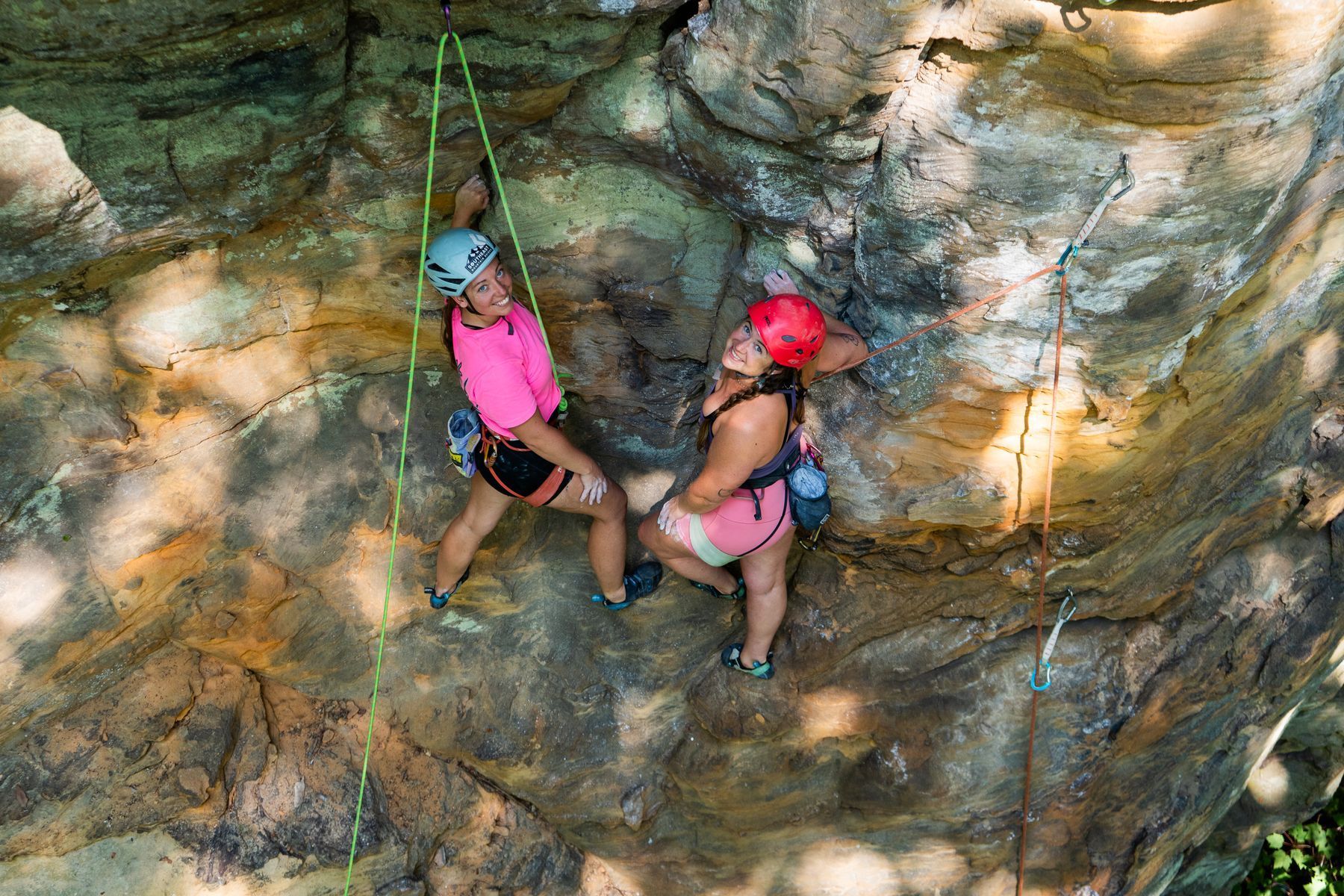
Red tags
If you’re newer to the Red, this one deserves explaining.
A red tag: Usually, literally a piece of red tape or webbing at the first bolt, means a route is claimed and closed. Either it isn’t finished, or the person who put in the work and the money hasn’t had their first ascent yet. In the Red, that’s been the local ethic for decades, and it’s enforced entirely by people choosing to honor it.
At a place like Cave Fork it carries more weight than usual. Jarek, one of our guides and a route developer out there, put it about as plainly as it can be put when we interviewed him about Cave Fork:
“Always respect red-tagged routes, as they may be unfinished or unsafe. Ignoring these rules could seriously jeopardize access and compromise future land acquisitions.”
That last clause is the real stake. The RRGCC’s ability to buy the next piece of land depends on being able to show landowners, funders and federal agencies that climbers manage a property responsibly. A rash of people poaching closed routes at Cave Fork is not a private disagreement between climbers. It shows up in the next negotiation.
Parking
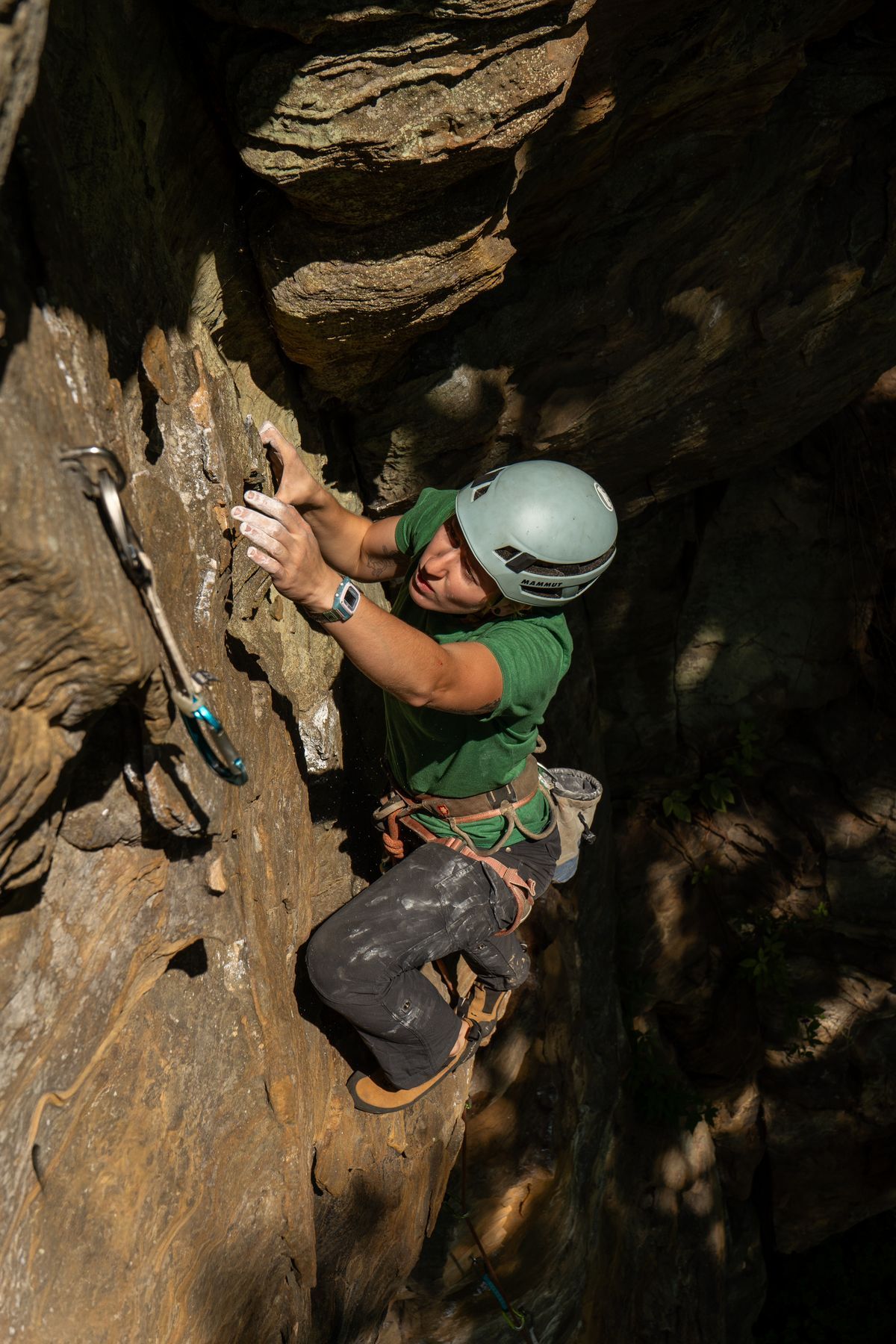
There are currently two parking lots, depending on which walls you plan to climb at.
Turn off KY-11 onto Ashland Camp Loop, then onto Cave Fork Road, which is dirt and gravel. Wind downhill for about half a mile and cross a small stream at the bottom. You’ll come to a blue gate — turn left to stay on the main road.
Immediately after that there’s a split:
- Down and right takes you to the Lake District lot — for Room 40, Romper Wall, Marie Antoinette, Oil Rig, Oz Wall and Guillotine.
- Left, another half mile and across a second stream, takes you to the large gravel Wilson Hollow lot — for The Venue, Casino, Zun’s, the Bunker, Hatchett and Grindstone.
That second stream crossing is the crux of the drive and it varies a lot with recent rain. 4WD is encouraged however, plenty of people get in with a normal car in dry conditions. After a wet week, think about it harder. Getting stuck out there is a long, expensive afternoon.
Specific to the Lake District
This side has its own rules, and they exist because of neighbours rather than erosion.
The gravel road around the lake is private property. You may walk it. You may not drive it, even when the gate is standing open. Cars have been locked in and towed. Park in the designated RRGCC lot and walk.
Don’t swim, fish or boat in the lake. It isn’t the Coalition’s water.
The clifftops above this area are part of a private development, and lots are being sold with cabins going in near the edge. Be aware of what’s above you. If you see debris coming over the cliff, report it to the RRGCC rather than handling it yourself.
Everywhere on the property
- No overnight parking. This applies at all RRGCC lots, and it is not a suggestion. Sleep at a campground.
- Leave gates closed and locked behind you.
- No off-road vehicles of any kind. No ATVs, no dirt bikes, no driving past the lots.
- No drones. RRGCC-wide policy.
- No hammocks on RRGCC property, at the crag or anywhere else.
- Sign the waiver. The Coalition requires a signed waiver to be on their preserves. It takes two minutes on your phone and it lives at rrgcc.org.
Trails
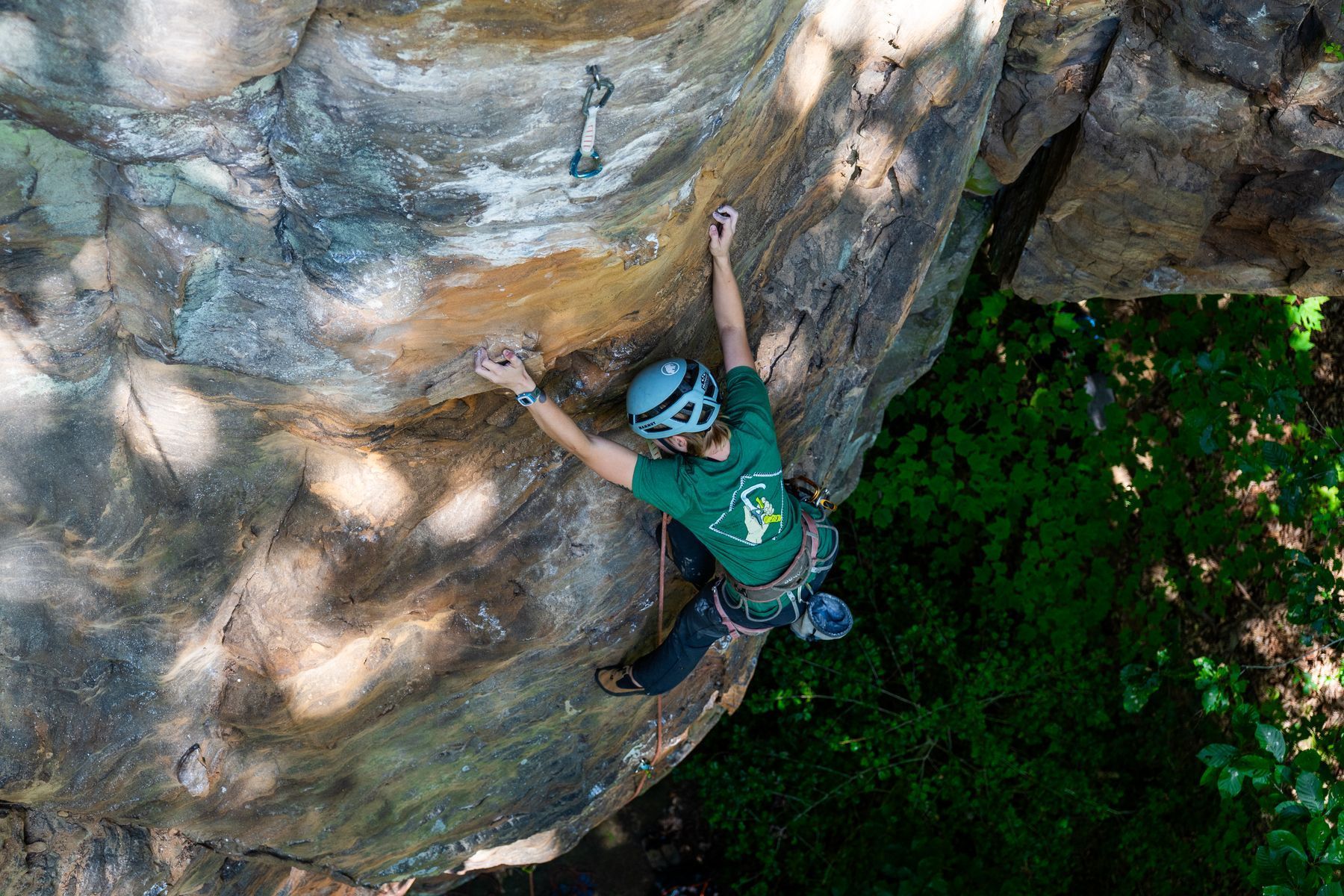
The approach trails at Cave Fork are new, and in some places they are new the way a trail is new when somebody finished it three weeks ago. The Lake District crags in particular went in fast this year, and the infrastructure is still catching up to the climbing.
The walk into the Venue is around a mile from the Wilson Hollow lot. It’s not brutal, but it is not the Motherlode trail either. Expect rougher tread, less signage, and a couple of spots where you’ll want to look up and make sure you’re still on it.
Please stay on the trail even where it would obviously be faster not to. Cutting a switchback at a twenty-year-old crag is bad manners. Cutting one on a six-month-old trail on a hillside that has never been walked before is how the trail gets destroyed, and the trail crew has to come back and rebuild what they just finished.
If a wall doesn’t have a trail to it yet, that’s the Coalition telling you it isn’t open.
What it took to get here
I want to spend a minute on this, because “the RRGCC bought some land” flattens an enormous amount of work into one sentence.
The deal itself took about a decade. Longtime board member Jereme Ransick is generally credited as the architect of it, and it required assembling money from sources that do not normally show up in the same room:
- $600,000 from the U.S. Forest Service, through the Community Forest Program
- $500,000 from the James Graham Brown Foundation
- $350,000 through the U.S. Fish & Wildlife Service and the Kentucky Natural Lands Trust, from the Imperiled Bat Conservation Fund
- $110,000 from RRGCC’s own reserves as the down payment
- Private loans from an anonymous donor and from Jordan Wood, to cover the gap
Add Black Diamond, the Access Fund, Ian Teal Real Estate and the Ventura family, plus several hundred individual climbers who gave $25 and $100 at a time. The bat money is worth pausing on: the property is habitat for Virginia big-eared bats and Indiana bats, and it holds designated critical habitat for the federally threatened Kentucky arrow darter. Conservation value is not a nice bonus on this purchase. It’s part of why the purchase was fundable at all.
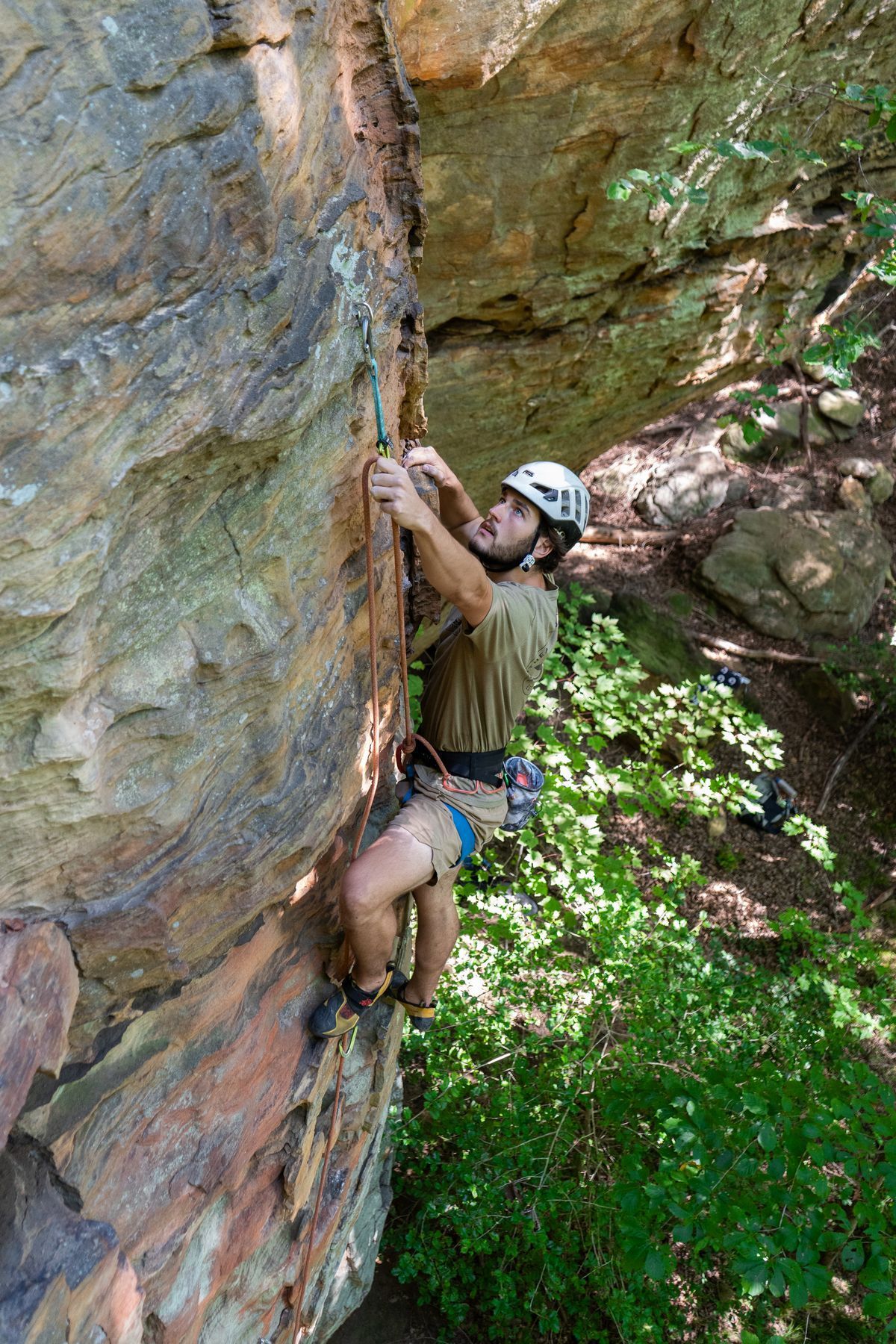
Then the actual labor started. Everything you can currently climb at Cave Fork exists because volunteers built a trail to it and developers paid for the hardware in it. The Venue was bolted ground-up, hold by hold, on lead, as the sequences were being figured out, by Jonathan and Eric Hörst, John Weaver and others. That is slower, harder and considerably more nerve-wracking than rappelling in from the top.
And then twelve more crags went in behind it, in about eighteen months.
None of those people got paid. The developers spent their own money on bolts, glue and drill batteries; the RRGCC’s Fixed Gear Initiative helps subsidize some of it, and it doesn’t come close to covering what a wall costs.
So: the trail you walk in on was dug by hand by somebody who took a Saturday off. The bolts you clip were bought by somebody who is not getting that money back. The land under both was paid for by a nonprofit that took on loans to do it and is still paying them down.
That’s the context for every rule in this post.
What’s coming
Three walls in the spring, fifteen now. There is no sign of that slowing down and there are still miles of undeveloped cliffline on the property, and the Coalition has been opening Cave Fork in batches as trail work lands rather than one crag at a time.
Which means the honest answer to “what’s open at Cave Fork” has a shelf life of about a season. Check the Mountain Project page before you drive out, and we’ll keep this post updated as things change.
If you want to help it move faster, three things actually matter:
- Donate to the RRGCC. The Ashland fundraiser is paying off acquisition loans and funding trails, parking and signage. Recurring monthly giving is worth more to them than a one-time gift.
- Show up to a trail day. The Coalition runs them through the season and announces them on social media.
- Follow the rules at the crag, including on the days when nobody would know.
If you want to climb out there with us
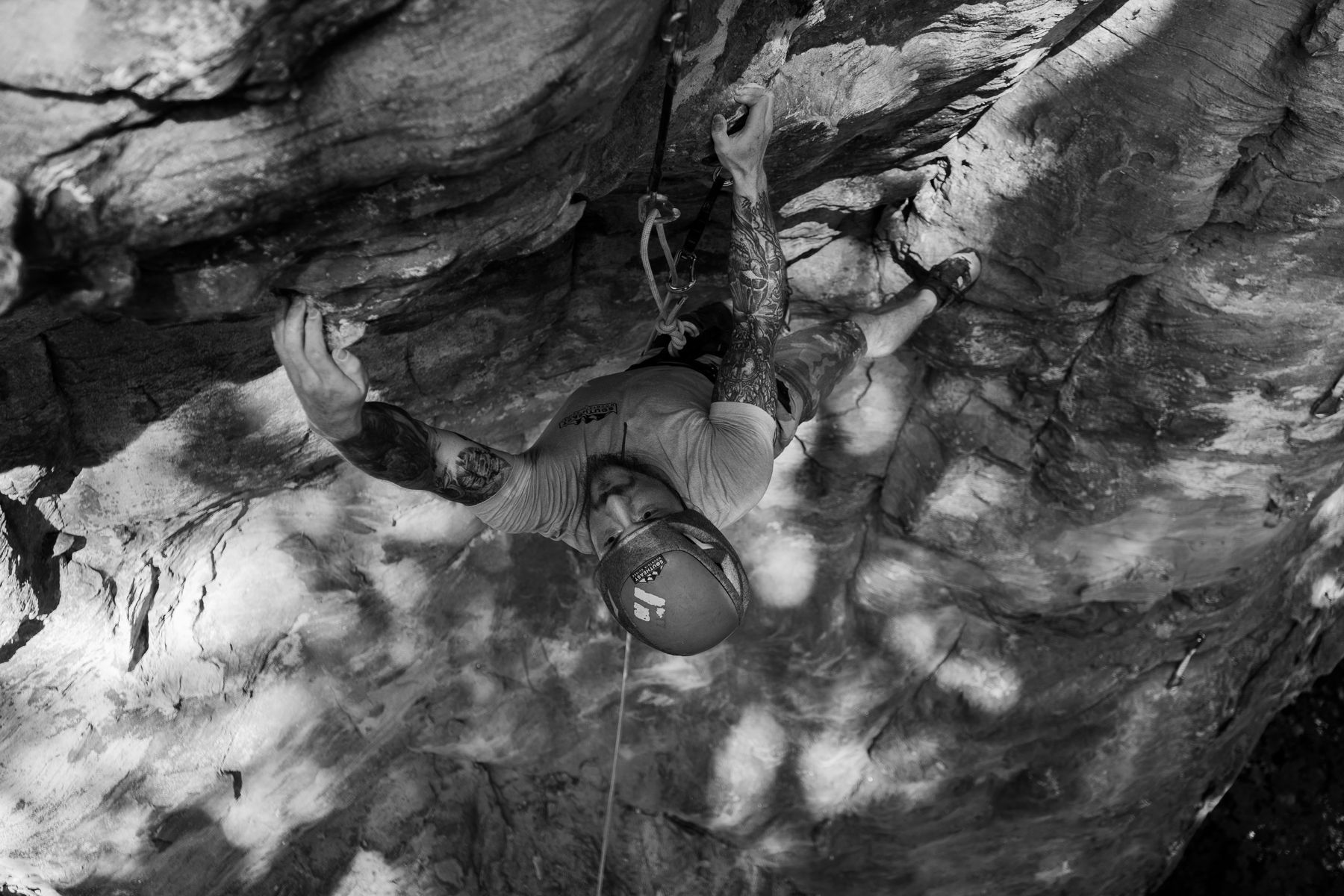
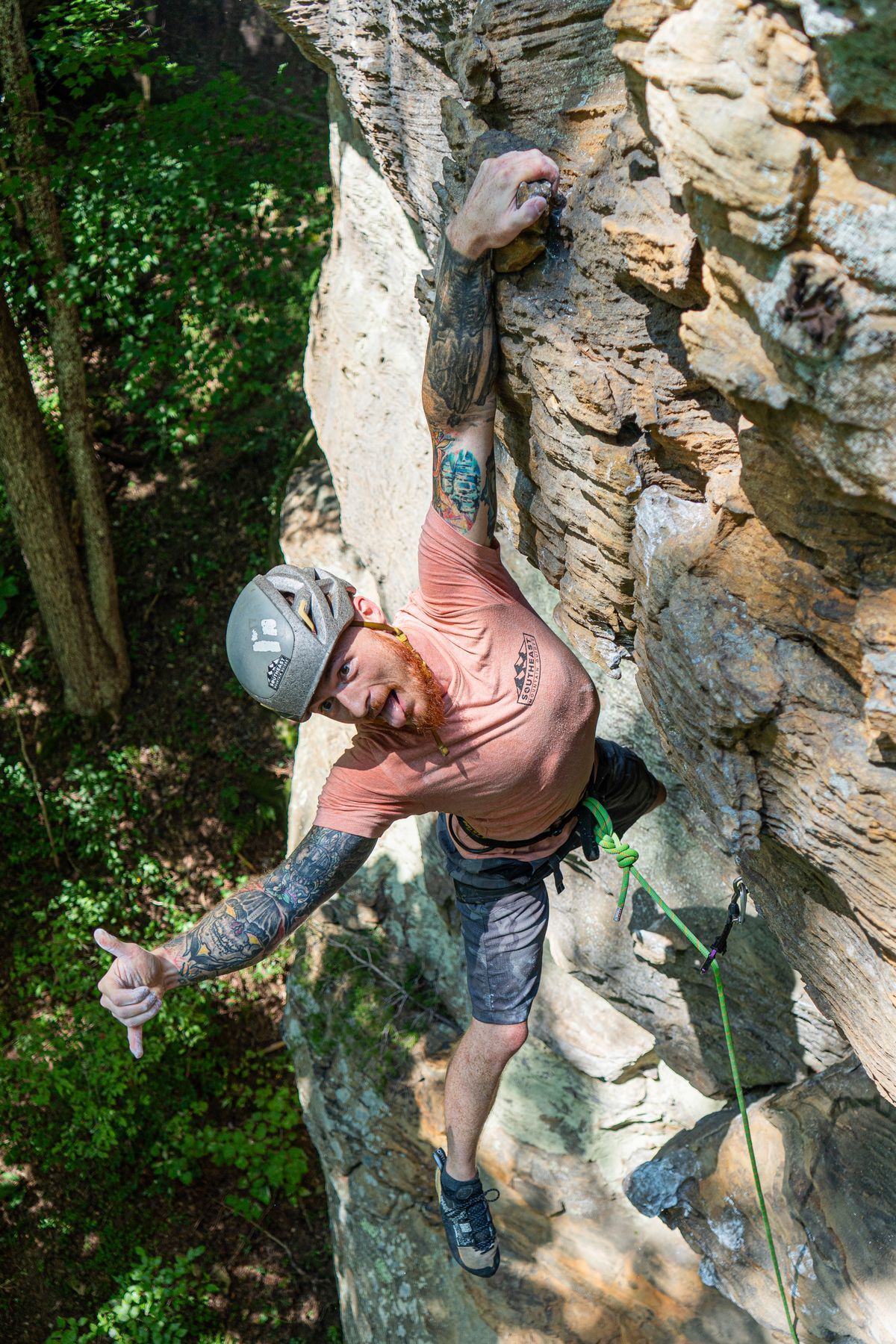
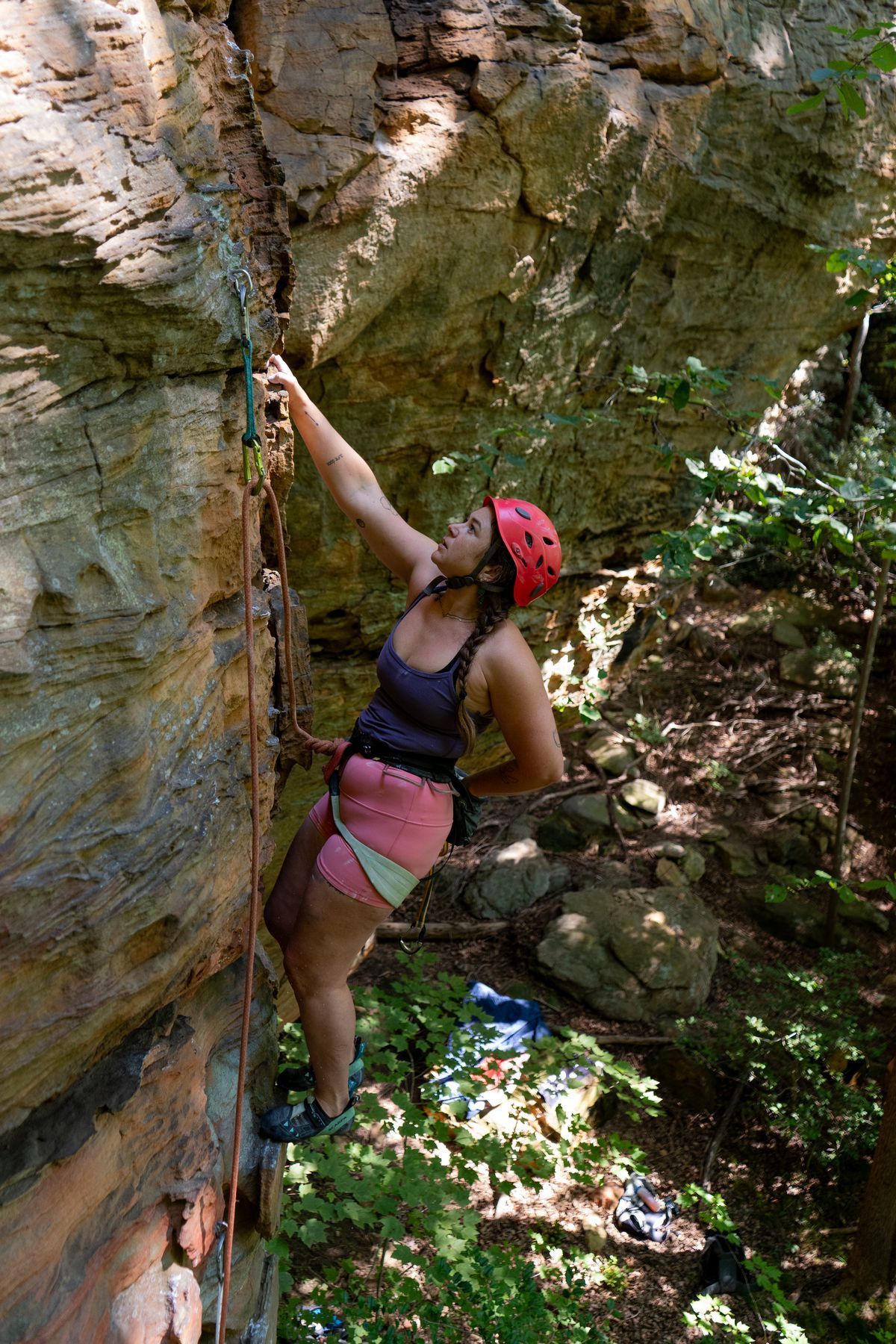
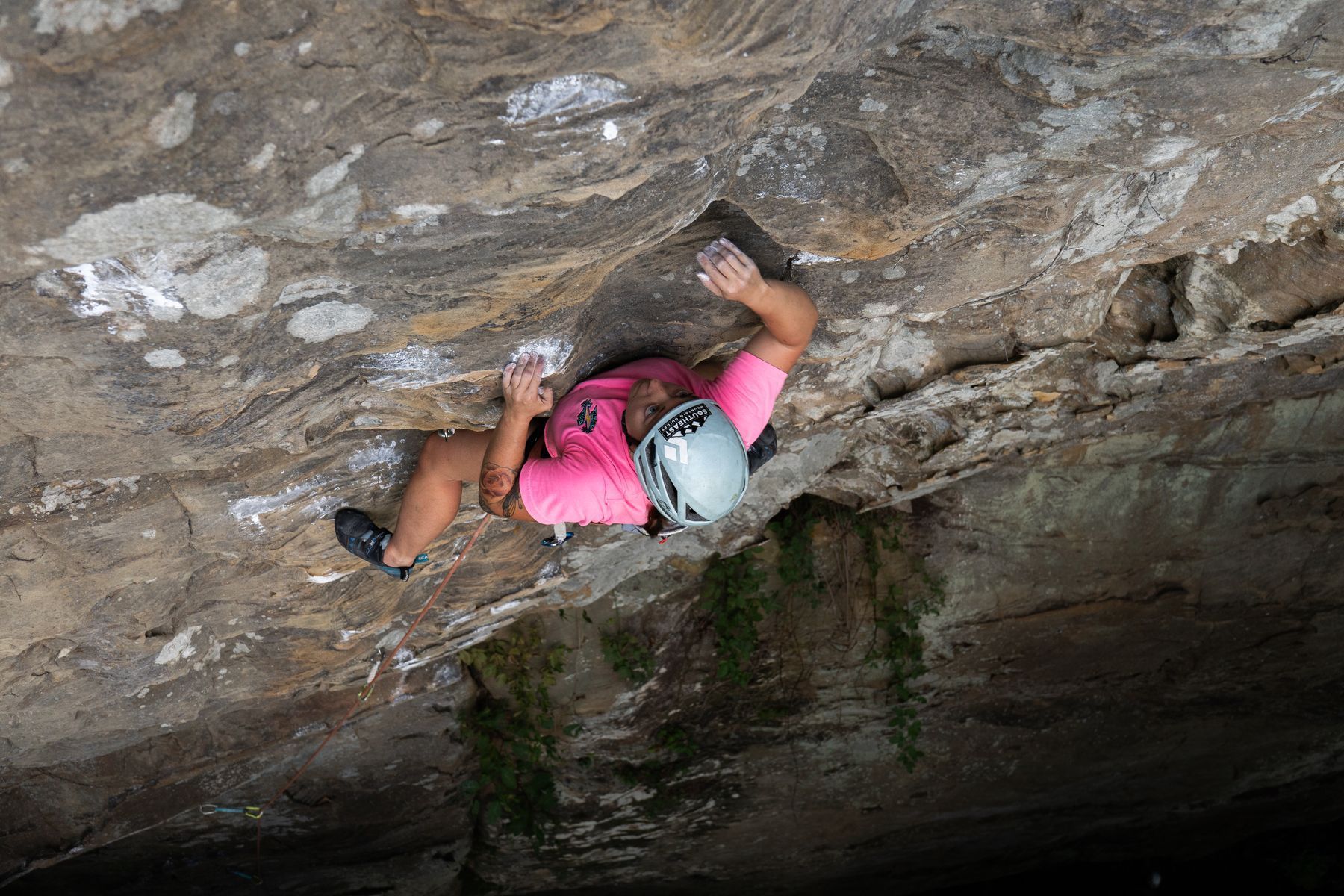
We guide across the Red River Gorge, and we’re happy to talk honestly about whether Cave Fork is the right day for you. A year ago the answer for most newer climbers was no. With the Aviary, Casino, Room 40 and Romper Wall open, it’s a much more interesting conversation.
Book a guided climbing day · Questions? Get in touch · Read our Cave Fork interview with Jarek Voyles
And before your next trip anywhere in the Gorge, Leave No Trace at the crag covers the habits that keep all of this open.